

Most title and legal issues on a California property can be cleared before or during a sale. A preliminary title report shows everything recorded against the house, and each problem has its own fix. Liens are usually paid from escrow at closing, a deceased owner is removed by affidavit or court order, and disputes go to quiet title.
Key takeaways
- A preliminary title report lists every lien, loan, and claim recorded against a California property, and it is where clearing any of them starts.
- Most liens on a California house are paid from the seller’s proceeds in escrow at closing rather than blocking the sale.
- When an owner on title has died, the fix depends on how title was held, from a recorded Affidavit of Death of Joint Tenant to a court petition or full probate.
- A paid-off mortgage still on title must be released by the lender under California Civil Code 2941, and a title insurer can record a release after 75 days.
- Ownership disputes, forged deeds, and old claims nobody will sign away usually need a quiet title action in California superior court.
It usually happens right after escrow opens. The title company sends over a preliminary report, and somewhere in the middle of it there’s a lien you’ve never heard of, a loan your parents paid off twenty years ago, or your late father’s name still sitting on the deed.
That moment feels like the sale just stopped, and for most people it hasn’t. A title problem is a paperwork problem with a specific fix, and once you know which kind you’re holding, you also know roughly who has to sign what and how long it’s going to take.
Below are the ones California homeowners and heirs run into most, in about the order they tend to show up.
A Title Problem Is Anything That Clouds Who Owns the House

A title problem, often called a cloud on title, is anything in the public record that makes it unclear who owns a California property or what is owed against it. The California Department of Insurance, which regulates title insurers, lists the defects title companies look for, and nearly all of them land in one of four groups:
- Money owed against the house. Contractor liens, court judgments, unpaid property taxes, and paid-off loans never released.
- Questions about who owns it. An owner who has died, missing heirs, a will nobody knew about, or a co-owner who won’t sign.
- Bad records. Errors in the public record, forged documents, and someone pretending to be the owner.
- Lines on the ground. Easements nobody mentioned and boundary disputes with a neighbor.
Inherited houses tend to collect problems from the first two groups at the same time, because the one person who could have signed a release or explained an old loan is no longer here to do it.
Some things feel like title problems and aren’t. A tenant with a lease doesn’t cloud the title, although it does change how the sale works, and that’s covered in the guide to selling with tenants in place.
Start With the Preliminary Title Report
A preliminary title report is the title company’s summary of everything recorded against a California property, and it’s the only reliable way to know what you’re dealing with before you try to fix anything.
Title companies build it by searching deeds, mortgages, court judgments, tax records, and liens, according to the California Department of Insurance. You don’t have to wait for a buyer to order one. An owner or an heir can ask a title company for a report before the house is listed, and if you already suspect something is wrong, it’s better to find out now than three weeks into escrow.
The part to read slowly is the list of exceptions.
Those are the items the title company won’t insure over until they’re paid, released, or cleared. Every lien, unreleased loan, and recorded claim shows up there with a recording date and a document number. That number is how an attorney or escrow officer tracks down whoever has to sign the release. Keep the report somewhere you can find it, because it gets asked for more than once.
Can You Sell a House With a Lien on It in California?

Yes, and most liens on a California house are paid off at closing from the seller’s proceeds instead of blocking the sale. Escrow pays the lien holder, the lien holder releases the lien, and the buyer takes clean title. Even the California Courts self-help guide tells creditors that a recorded lien usually gets them paid when the owner sells or refinances.
The real question is whether there’s enough equity to cover all of it, and whether any of the liens have expired before you pay them.
| Lien type | How it gets on title | Time limits in California | How it usually clears |
| Contractor (mechanics) lien | The contractor records a claim of lien with the county | Must be recorded within 90 days after the work is finished or 60 days after the owner records a notice of completion, whichever comes first (Civil Code 8412), then enforced by lawsuit within 90 days of recording (Civil Code 8460) | Paid in escrow, or removed by court order if it expired (Civil Code 8480) |
| Judgment lien | A creditor records an Abstract of Judgment in the county where the property sits | Most civil judgments last 10 years and can be renewed before they expire | Paid from the sale proceeds in escrow |
| Property tax lien | Unpaid taxes attach to the property automatically | The tax collector can auction a home after five years in tax default, and commercial property or vacant land after three, according to Los Angeles County’s tax sale notices | Paid in escrow, and redeemable up to the business day before the auction |
The contractor lien is the one worth slowing down on. A contractor who never files a lawsuit within 90 days of recording has let the lien expire under Civil Code 8460, but it stays on the record until someone gets it removed. The owner can send a written demand and, if the contractor won’t release it, petition the court for a release order under Civil Code 8480 through 8488, and the winning side can recover reasonable attorney’s fees. Paying an expired lien at closing without checking the dates can mean paying a debt nobody could have collected.
Unpaid property taxes run on a much longer clock than a contractor lien. The full picture of what happens along the way is in the post on unpaid property taxes, and every lien type gets its own walkthrough in the guide to selling a house with liens.
If the liens add up to more than the house is worth, that’s a different conversation, and it usually means negotiating a reduced payoff with each lien holder before escrow can close.
When the Person on Title Has Passed Away
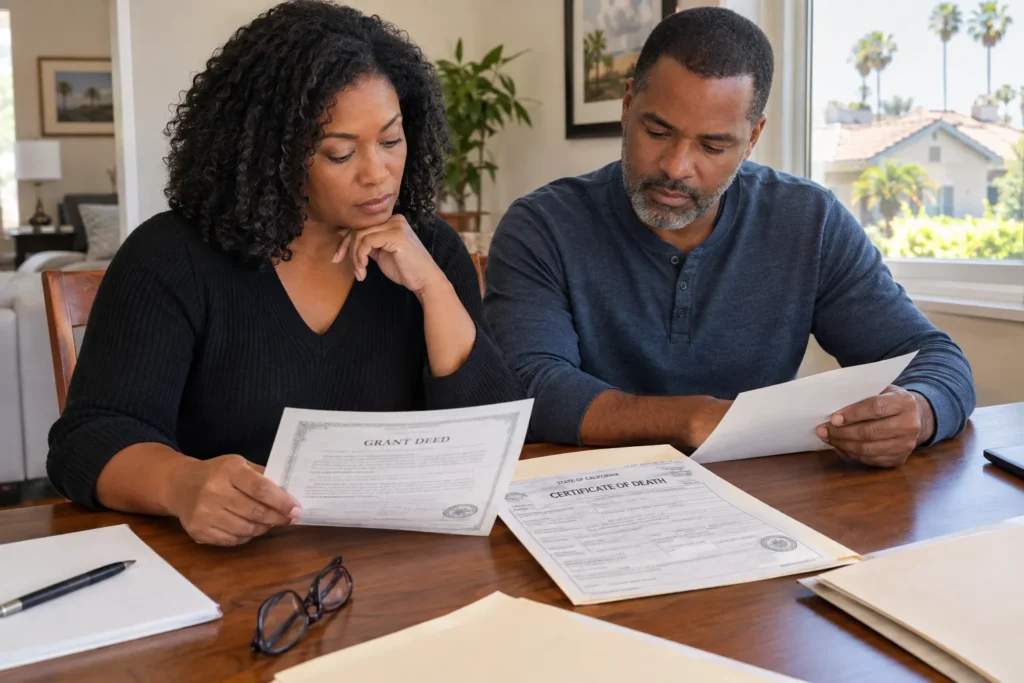
When a California homeowner dies, their name stays on the deed until someone records the document that moves title to whoever inherits it, and no one can sell the house until that happens.
If you’re doing this after losing a parent, it’s a lot to carry, and none of it has to be figured out in one afternoon.
Which document you need depends on how your parent held title, and the California Courts transfer guide sets out the main routes:
- Joint tenancy with a surviving owner. The survivor gets the property and records an Affidavit of Death of Joint Tenant with a certified copy of the death certificate. The Los Angeles County Registrar-Recorder charges $18 for the first page and $3 for each page after that, plus small redaction and e-recording fees.
- A living trust. Property in a living trust passes to the beneficiaries without probate court, and the successor trustee named in the trust handles the transfer or sale.
- A smaller estate. For deaths on or after April 1, 2025, heirs can ask the court to transfer a primary residence worth up to $750,000 through a shorter petition under Probate Code 13150 to 13157. Other real property qualifies for a simpler affidavit only up to $69,625.
- Everything else. The house goes through probate first, and the guide to how probate sales work explains what the court needs before anyone can sign a deed.
The $750,000 figure is the one most families haven’t heard about yet. It took effect in 2025, up from a $184,500 limit before that, and as of 2026 it means many more family homes in Los Angeles County can skip full probate than could just a couple of years ago. If the house is part of a larger estate, the post on selling an inherited home covers what comes after title is in your name.
A Paid-Off Loan Still Showing Up Is Usually the Easiest Fix
An old mortgage that was paid off but never removed from title is one of the most common clouds on a California house, and state law puts the job of fixing it on the lender, not on you.
Under California Civil Code 2941, once a loan is paid, the lender has 30 days to send the paperwork to the trustee, and the trustee has 21 days after that to record a full reconveyance, which is the document that formally releases the deed of trust. If 75 days pass and nothing is recorded, a title insurance company is allowed to prepare and record the release itself, and a lender or trustee who breaks the rule owes the owner $500 plus any damages the delay caused.
The hard part is usually proving a loan your parents closed out decades ago was paid. A final payoff statement, a paid-in-full letter, or the name of the lender that bought the old loan is what the title officer will ask for, so go through the file cabinet before you call.
What If a Co-Owner or Heir Won’t Sign?

Everyone who owns a share of a California house has to sign to sell the whole property, so one person who won’t sign can stall the sale indefinitely.
Most of the time the holdout isn’t being difficult for fun. They’re grieving, or living in the house, or scared of what a sale means for them. The conversation usually goes differently once someone takes those worries seriously and puts real numbers in front of everyone. The post on when heirs don’t agree goes through the options families try first.
When talking doesn’t work, California lets any co-owner ask a court to divide the property or order it sold through a partition action under Code of Civil Procedure 872.210. It’s a lawsuit, it costs money on both sides, and it’s why every other conversation is worth trying first.
Divorce raises the same signature problem between two spouses, with a family court judge involved, and that’s covered in the guide to selling before a divorce is final.
What Is a Quiet Title Action?
A quiet title action is a lawsuit asking a California superior court to declare who owns a property and to clear away claims that don’t hold up.
Code of Civil Procedure 760.020 allows one against any adverse claim to real property, which makes it the tool for problems nobody will sign away: a lien holder who can’t be found, a gap in the chain of ownership, a boundary fight, or a forged deed.
Because it’s a lawsuit, it runs on the court’s calendar instead of yours. The person bringing it has to name everyone with an adverse claim as a defendant under Code of Civil Procedure 762.010. The judgment is only as clean as that list, so a missed name can leave the problem half fixed. A real estate attorney who handles title work is the right person for this, and it helps to ask the title company that will insure the sale what it needs to see in the judgment before anything is filed.
Forged Deeds and Recording Errors
Forgery and false impersonation are on the California Department of Insurance’s own list of title defects, and they’re hardest to catch when nobody is living in the house to open the mail.
Los Angeles County runs a free Homeowner Notification Program through the Registrar-Recorder/County Clerk. It mails the owner a copy when a document showing an ownership change, a new loan, or a notice of default is recorded against the property, and owners can also sign up for email alerts through the Assessor’s portal.
If you’re handling a parent’s house from out of state, signing up takes a few minutes and it’s one of the most useful things you can do for the house.
Plain mistakes count too, like a misspelled name or the wrong legal description on a deed, and the title officer on your file is the first person to ask.
Fix the Title First or Sell With It

Whether to clear the title before selling comes down to what the problem is and how much time and money you can put into fixing it.
If the only issue is an unreleased loan or a small lien with plenty of equity behind it, clear it and list the house, and a cash sale is probably the wrong choice. On an $800,000 house, a 5% to 6% agent commission comes to $40,000 to $48,000, and when the only problem is paperwork, the open market is still usually where the higher price is.
When the fix involves a lawsuit, a probate case, or co-owners who can’t agree, some sellers would rather sell as-is to a buyer who will wait out the title work and coordinate with the attorney and title company. Mrs. Property Solutions is one of those buyers, and the page on an inherited house in probate explains how that works when a deceased owner is part of the problem.
If You’d Rather Not Carry This Alone
If you’ve read this far, there’s a good chance you have a preliminary report on the table and more questions than you started with, and that’s a normal place to be.
Mrs. Property Solutions is a mom-and-pop cash home buyer in Los Angeles County. We buy houses as-is, including houses with liens, a deceased owner still on title, or heirs still working things out, and we work alongside your attorney and the title company until the title is clear enough to close.
Since 2016 · 150+ homes purchased · 50+ five-star reviews · Local to LA County · No repairs, no commissions · The offer we make is the offer we honor
Call us at 626-344-9579 or request an offer online, and send the preliminary report if you have one. There’s no obligation, and if the better move for you is to clear the title and list with an agent, we’ll tell you that.
Frequently Asked Questions
Can you sell a house with a lien on it in California?
Yes. Most liens on a California house are paid from the seller’s proceeds in escrow at closing, and the lien holder then records a release. A sale only stalls when the liens add up to more than the sale price or a lien holder disputes the payoff amount, and that has to be negotiated before closing.
How long does a contractor’s lien last in California?
Ninety days after it’s recorded, unless the contractor files a lawsuit to enforce it. Under California Civil Code 8460, a mechanics lien that isn’t enforced within 90 days of recording expires, and the owner can petition the court for a release order under Civil Code 8480 if the contractor won’t release it.
How do I get a deceased parent’s name off a house deed in California?
It depends on how your parent held title. A surviving joint tenant records an Affidavit of Death of Joint Tenant, a successor trustee handles trust property, and for deaths on or after April 1, 2025, a primary residence up to $750,000 can use a shorter court petition. Everything else usually goes through probate.
What if my paid-off mortgage still shows on the title?
The lender is required to fix it. Under California Civil Code 2941, the lender has 30 days after payoff to request a reconveyance and the trustee has 21 days to record it. After 75 days, a title insurance company may record a release, and a violator owes the owner $500 plus damages.
Do I need a lawyer to clear a title problem in California?
Not always. An unreleased loan or a lien paid in escrow is often handled by the escrow and title officers alone. Quiet title actions, partition cases, probate, and forged or disputed documents are court matters, and a California real estate or probate attorney should handle those.
Will a title problem stop escrow from closing?
Usually, until it’s resolved. A title company won’t issue a clean policy while an exception on the preliminary report is still open, and most buyers and lenders won’t close without one, so each lien, unreleased loan, or ownership question has to be paid, released, or cleared before the sale can record.
Can I sell a house with title problems to a cash buyer?
Yes, but the title still has to be clear enough to insure at closing. What a cash buyer changes is who carries the waiting and the coordination. Some buyers, including Mrs. Property Solutions, purchase as-is and work with the seller’s attorney and title company while liens, probate, or co-owner issues get resolved.
Disclaimer: This article explains how title and legal issues generally work in California. It isn’t legal or tax advice, and the rules vary by county and by situation. Talk to a California real estate or probate attorney about your specific property.