

Selling an inherited house in Los Angeles starts with one question: who has the legal right to sign. That is an executor or administrator in probate, a successor trustee if the house was in a living trust, or an heir with a court order. After that the sale works like any other, and stepped-up basis usually keeps the tax low.
Key Takeaways
- Nobody can sell an inherited house in California until someone holds legal authority to sign, whether that comes from the probate court, a living trust, or a small-estate court order.
- A house held in a living trust or in joint tenancy generally passes without probate, and since April 1, 2025, a California primary residence worth up to $750,000 can transfer through a shorter court petition.
- Inherited property gets a stepped-up tax basis equal to its value on the date of death, so capital gains tax usually applies only to growth after that date.
- Under Proposition 19, a child keeps a parent’s lower property tax assessment only by moving into the house as a principal residence and filing for the homeowners’ exemption within one year.
- The three common ways to sell an inherited house in Los Angeles County are listing with an agent, selling as-is to a cash buyer, or selling to a relative, and listing usually nets more when the house is in good shape and nobody is in a hurry.
Nobody plans to sell a house when a parent dies. You’re handling the funeral, calling the bank, looking for the insurance papers, and somewhere in the middle of all of it you realize there’s a whole house in Los Angeles that now belongs to you and maybe your brothers and sisters, still full of everything your mom or dad kept.
Selling that house is less complicated than it looks from the outside, even though the order of the steps matters more than most people expect. A lot of the stress we see comes from heirs who list the house, accept an offer, or start clearing it out before anyone has the legal right to sell, and then have to stop and back up.
If you’re reading this in the first weeks after a loss, take the part you need today and leave the rest for when you’re ready.
Who Has the Legal Right to Sell the House
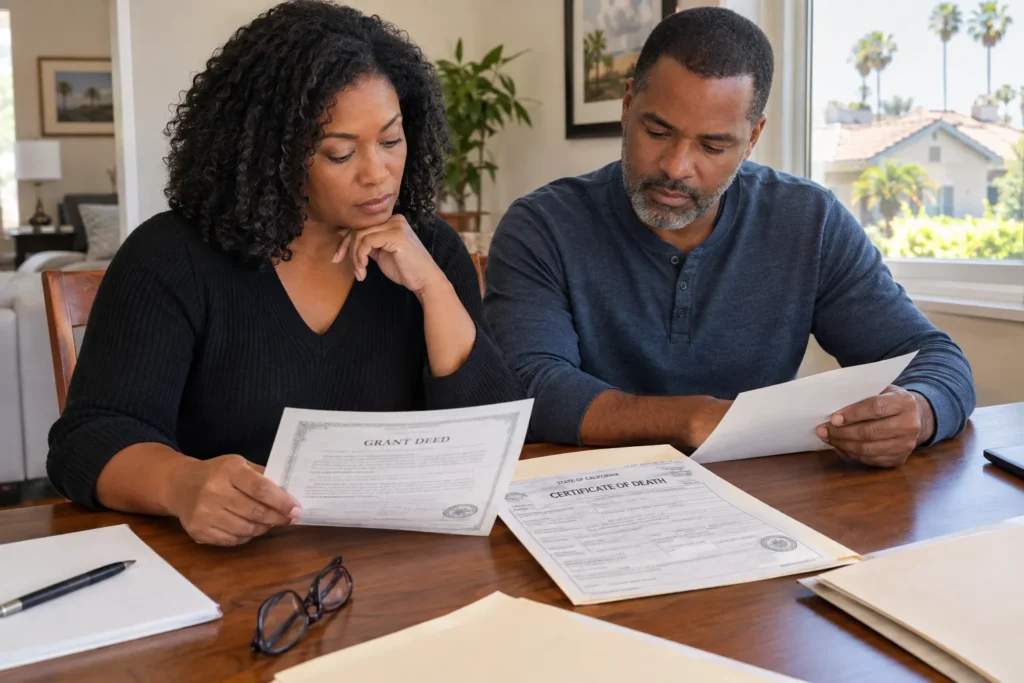
The person with the right to sell an inherited house in California depends on how the house passed, and until that person has authority on paper, no escrow or title company can close the sale.
| How the house passed | Who signs the sale | Is a court involved |
| House was in the parent’s name alone, with or without a will | The executor named in the will, or an administrator the court appoints | Yes, through probate |
| House was in a living trust | The successor trustee named in the trust | Usually not |
| House was held in joint tenancy | The surviving joint owner | No probate for the house |
| Primary residence worth $750,000 or less, no trust | The heir, once a judge grants a Petition to Determine Succession | Yes, but a shorter petition instead of full probate |
According to the California courts, property held in joint tenancy or placed into certain living trusts is not handled in probate court. That’s why the first thing to find is the most recent deed and any trust paperwork, because those two documents settle most of the question before you ever talk to a lawyer or a buyer.
The last row is new. A change to state law raised the limit for the Petition to Determine Succession to $750,000 for deaths on or after April 1, 2025, and the procedure now applies only to the parent’s primary residence in California, according to the Judicial Council’s summary. For a lot of Los Angeles families whose parents owned a modest home outright, that can mean a court hearing on a petition instead of a full probate case, and it’s worth asking a probate attorney about before assuming the longer path.
When the house does go through probate, the court gives the executor or administrator a document called letters, which is the proof of authority every buyer, title company, and escrow officer will ask to see. Our guide to how probate works in California walks through that process step by step.
Can You Sell an Inherited House Before Probate Is Finished?

Yes, an inherited house in California can usually be sold during probate, as soon as the court has issued letters, and the estate does not have to wait for the case to close.
How the sale works depends on the kind of authority the court granted. With full authority under California’s Independent Administration of Estates Act, the executor can sell without court supervision by sending the heirs a Notice of Proposed Action, and heirs who don’t object in time are treated as having agreed, as explained on the court’s notice form. With limited authority, there is no power to sell real property without court supervision, so the sale goes to a confirmation hearing where other buyers can show up and bid more.
That hearing adds time, and it means the buyer you found, cash or financed, can be outbid right there in the courtroom.
Which kind of authority you have is printed on the letters, so check before you talk to any buyer.
If you want the details on selling during an open probate, or on how long probate usually takes in California, both have their own guides.
Stepped-Up Basis Keeps the Tax Bill Smaller Than Most Heirs Expect

When you inherit a house, your tax basis is generally its fair market value on the date your parent died, not what they paid for it, according to IRS Publication 551.
Here’s how that plays out. Say your parents bought their house for $100,000 in 1980, it was worth $600,000 on the day your mom passed, and you sell it for $615,000. The taxable gain is generally $15,000, before selling costs, and not the $515,000 difference between the old purchase price and the sale. We talk to heirs who have held onto a house for years because they were afraid of a capital gains bill that was never going to be that large.
California adds one more benefit for married couples. When a house is community property and one spouse dies, the IRS says the whole property generally gets a new basis, not just the half that belonged to the spouse who died, which can matter a great deal when the surviving parent later passes too.
The one thing to do now, even if you aren’t ready to sell for a year, is get a written appraisal of what the house was worth on the date of death. That number is what your CPA will build everything else on, and it’s much harder to reconstruct later. There’s more on taxes on the sale in a separate guide, and the rules shift a little for an inherited rental property.
Keeping the House Means Checking Prop 19 First
Under Proposition 19, a child who inherits a parent’s house keeps the parent’s lower property tax assessment only if the child moves in as a principal residence and applies for the homeowners’ exemption within one year, according to the State Board of Equalization.
Even then the benefit has a ceiling. For transfers between February 16, 2025 and February 15, 2027, the exclusion covers the parent’s taxable value plus $1,044,586, and value above that gets reassessed.
If the plan is to rent the house out or keep it as a second place, it gets reassessed to current market value, and for a house a parent bought decades ago that can turn a small tax bill into a much larger one. Plenty of families decide to keep an inherited house as a rental based on what the parents were paying, and the numbers stop working the first time the new bill arrives. Run the keep-or-sell math with the reassessed number, not the old one.
When More Than One Person Inherited the House

When siblings inherit a house together, who has to agree depends on where the house sits. In probate, the executor or administrator signs and the other heirs get notice and a chance to object, in a trust the successor trustee signs, and once the house has been deeded to several heirs, every owner has to sign.
Sibling disagreements keep a lot of inherited houses sitting empty longer than anyone wants, so it helps to read up on when heirs don’t agree before the conversation gets heated, along with our guide to selling with your siblings.
What to Do With the House While Authority Gets Sorted Out
The months between a parent’s death and a signed sale are when an inherited house in Los Angeles County is most exposed, sitting empty while the bills keep coming, and a few calls early on prevent most of the problems.
- Call the homeowner’s insurance company, tell them the owner has passed and whether the house is empty, and ask what changes for a vacant home.
- Keep the utilities on and keep paying the property taxes and any mortgage from estate funds if you can, and read up on an inherited mortgage if there’s still a loan on it.
- Change the locks and have someone check on the house regularly, and there’s a full checklist on securing an empty house.
- Hold off on giving away furniture or valuables until the executor or trustee says the estate is ready, since some of it may need to be divided or appraised.
- Look for the deed, the will, any trust, mortgage statements, and the latest property tax bill, and keep them together.
If you live out of state, most of this can still be handled from a distance, and we’ve written separately about selling from out of state.
Your Three Options for Selling an Inherited House in Los Angeles

An inherited house in Los Angeles County can be sold three main ways: listed with a real estate agent, sold as-is to a cash buyer, or sold to a relative or someone you already know.
| Path | Usually the right fit when | What it costs you | How long it takes |
| List with an agent | The house is in decent shape, the heirs agree, and nobody needs the money soon | A 5% to 6% commission, which is $48,250 to $57,900 on a $965,000 house, plus any repairs and prep | Depends on prep work, showings, and the buyer’s loan |
| Sell as-is to a cash buyer | The house needs work, is still full of belongings, or the heirs live far away and want a set date | A lower price than a fixed-up listing would bring, with no commission and no repairs | Often two to three weeks, since there’s no lender underwriting |
| Sell to a relative or someone you know | A family member or neighbor wants the house | No commission if no agent is involved, but you handle the paperwork and their financing timeline | Depends on the buyer’s loan |
That $965,000 figure is the median listing price for Los Angeles County in August 2026, from median listing price data published through the Federal Reserve Bank of St. Louis.
If the house is in good condition, the heirs agree, and nobody needs the money quickly, listing it with a good agent will usually put more money in your pocket than any cash buyer will, including Mrs. Property Solutions, and that’s the honest answer even though we buy inherited houses for a living. A cash sale makes sense when the repairs, the cleanout, the distance, or the family tension cost more than the difference in price.
A Burbank house Mrs. Property Solutions bought in 2024 shows where that line sits. Two sisters inherited it from their father, who passed without a trust, and both lived out of state. The house had foundation problems, it was still full of decades of his belongings, and it was in probate. Their probate attorney handled the court side, the sisters took only what they wanted from the house, and it closed in 21 days for exactly the amount in the original offer, without either of them flying back to California.
One thing a cash offer doesn’t change is the court. If the executor has limited authority, a cash sale still goes to a confirmation hearing like any other.
Thinking About Selling an Inherited House in Los Angeles
After reading all of this, you probably have a clearer picture of who signs, what the taxes look like, and which way of selling fits your family.
Mrs. Property Solutions is a small, local team in Pasadena that buys inherited houses as-is across Los Angeles County. We work directly with probate attorneys and trustees, you choose the closing date, and we take care of the cleanout so your family can keep what matters and leave the rest behind.
Since 2016 · 150+ homes purchased · 50+ five-star reviews · Local to LA County · No repairs, no commissions · The offer we make is the offer we honor
You can read more about how we buy inherited houses, or call us at (626) 344-9579 to talk it through. There’s no obligation to take our offer, and if listing the house is the better move for your family, we’ll tell you that.
Frequently Asked Questions
Can I sell an inherited house before probate is complete in California?
Yes. An executor or administrator can usually sell an inherited house once the court issues letters, without waiting for probate to close. With full authority, the sale goes forward after a Notice of Proposed Action to the heirs. With limited authority, the court must confirm the sale at a hearing where other buyers can bid.
Do I have to pay capital gains tax when I sell an inherited house?
Usually only on growth after the date of death. An inherited house generally gets a stepped-up basis equal to its fair market value on the day the owner died. If you sell soon for close to that value, the taxable gain is often small. A CPA can confirm the numbers for your situation.
Does a house in a living trust have to go through probate in California?
No, not usually. A house held in a living trust generally passes outside of probate, and the successor trustee named in the trust can sell it without a court hearing. The trustee still needs the trust document, a death certificate, and title company requirements met before the sale can close.
What is the $750,000 rule for inherited homes in California?
It is the value limit for a Petition to Determine Succession. For deaths on or after April 1, 2025, a California primary residence worth up to $750,000 can pass to heirs through this shorter court petition instead of full probate. The procedure applies only to the decedent’s primary residence.
Will my property taxes go up if I keep my parent’s house?
Probably, unless you move in. Under Proposition 19, a child keeps the parent’s assessed value only by making the house a principal residence and filing for the homeowners’ exemption within one year. A rental or second home is reassessed to current market value, which often raises the bill.
Do I have to clean out an inherited house before selling it?
No, not always. A house listed with an agent is usually emptied and cleaned before showings. A house sold as-is to a cash buyer can usually be sold with belongings still inside, and the buyer handles the cleanout. Take family photos, documents, and keepsakes out first either way.
Do I have to report the sale of an inherited house to the IRS?
Yes. The sale of an inherited house is generally reported on your federal return for the year it sold, usually on Form 8949 and Schedule D. Your basis is typically the house’s fair market value on the date of death, so keep the date-of-death appraisal with your tax records.