
In Los Angeles, the seller and the buyer each pay their own set of closing costs. Sellers usually pay agent commissions, the owner’s title insurance policy, the county and any city transfer tax, and half the escrow fee. Buyers usually pay their loan costs, inspections, and the other half of escrow. The signed purchase agreement has the final say.
The Short Version
- Local custom sets the starting point in Los Angeles County, but the signed purchase agreement decides who pays each closing cost, and every line on it can be negotiated.
- Sellers in Southern California usually pay the owner’s title policy, the transfer tax, half the escrow fee, HOA document fees, and any agent commission they agreed to.
- Los Angeles County charges a transfer tax of $1.10 per $1,000 of the sale price, the City of Los Angeles adds $4.50 per $1,000, and Measure ULA applies to city sales above $5.4 million as of July 1, 2026.
- California can hold back 3 1/3% of the sale price at closing toward state income tax, although many homeowners qualify for an exemption.
- When an investor buys a house for cash, the investor often pays the standard closing costs, so the offer amount and the check at closing can be the same number.
Most sellers don’t think much about closing costs until escrow sends over the estimated closing statement, and then they’re looking at a page of line items with names like documentary transfer tax, owner’s policy premium, and NHD report, trying to work out why the number at the bottom is smaller than the price they agreed to.
Every one of those lines belongs to somebody.
Some are yours as the seller, some are the buyer’s, and a few can go either way depending on what got written into the contract. This guide walks through who pays what in a Los Angeles County sale, what the taxes cost in dollars, and where the numbers change from one city to the next, so you can read that page before escrow ever sends it.
Who Pays for What When You Sell a House in Los Angeles
In Los Angeles County, the seller usually pays the costs of transferring the house and the buyer usually pays the costs of financing and inspecting it, and the purchase agreement settles everything else.
None of this is set by law, which surprises a lot of people. The California Department of Real Estate explains in its consumer guide to escrow that the escrow fee is customarily split, that Northern and Southern California follow different customs, and that buyer and seller can agree to any arrangement as long as it’s written into the purchase contract.
So the table below is the common starting point for a Los Angeles County sale, and it’s where most negotiations begin.
| Closing cost | Who usually pays in LA County | Negotiable? |
| Listing agent commission | Seller | Yes |
| Buyer’s agent compensation | Buyer, unless the seller agrees to pay it | Yes |
| Owner’s title insurance policy | Seller | Yes |
| Lender’s title insurance policy | Buyer | Yes |
| Escrow fee | Split between seller and buyer | Yes |
| County and city transfer tax | Seller, as written in the contract | Yes |
| HOA document fees | Seller (the HOA bills the seller) | Reimbursement only |
| Natural hazard disclosure report | Seller | Yes |
| Loan fees, appraisal, inspections | Buyer | Yes |
| Recording the buyer’s deed and loan | Buyer | Yes |
| Property taxes and HOA dues | Split by the calendar to the closing date | No |
Treat that table as a starting point, not a rule.
What the Seller Pays at Closing, Besides the Commission
Aside from agent commissions, a Los Angeles County seller typically pays for the owner’s title policy, the transfer tax, half the escrow fee, HOA document fees if there’s an association, and the natural hazard disclosure.
Owner’s title insurance. This policy protects the new owner against old claims on the title, like a forgotten lien or a mistake in a past deed. The California Department of Insurance says in its title insurance guide that local custom, not law, decides who pays the premium, and that in Southern California the seller usually does. Every title company files its own rates with the state and those rates differ, which is why escrow can quote you an exact figure for your house and a general article can’t.
Escrow. The escrow fee pays the neutral third party who holds the money and the documents until both sides have done what the contract says, and in Southern California it’s normally split down the middle.
HOA documents. If the house is in a homeowners association, California Civil Code section 4530 lets the association charge the seller a reasonable fee, based on its actual cost, for the documents the buyer is entitled to see, and that fee has to be itemized separately on the statement.
Natural hazard disclosure. California Civil Code section 1103 requires sellers to disclose whether the property sits in a flood zone, a very high fire hazard severity zone, or an earthquake fault or seismic hazard zone. Most sellers hire a report company to prepare it, and it’s a small line compared to everything else.
Prorations. Property taxes and HOA dues get divided by the calendar, so if you’ve paid for days after closing you get a credit back, and if you’re behind, the difference comes out of your proceeds. Your mortgage payoff and any liens come out of the proceeds too, although those are debts rather than closing costs, and they’re covered in the guide to the full cost of selling.
Los Angeles Transfer Tax Depends on the City the House Is In
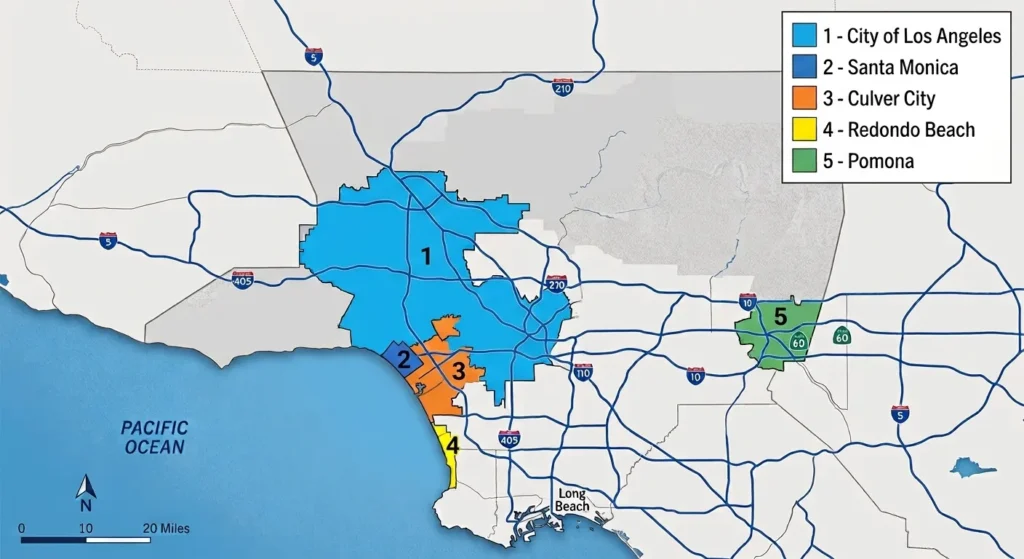
Every home sale in Los Angeles County pays the county documentary transfer tax of $1.10 per $1,000 of the sale price, and a handful of cities add their own tax on top of it, according to the Los Angeles County Registrar-Recorder.
| Where the house is | City tax | Total transfer tax on an $800,000 sale |
| Unincorporated LA County or a city without its own tax | None | $880 |
| City of Los Angeles | $4.50 per $1,000 | $4,480 |
| Culver City | 0.45% up to $1,499,999, with higher tiers above that | $4,480 |
| Pomona | $2.20 per $1,000 | $2,640 |
| Redondo Beach | $2.20 per $1,000 | $2,640 |
| Santa Monica | Tiered by price | Check the Recorder’s rate table |
The city boundary matters more than the mailing address, because plenty of homes with a Los Angeles mailing address sit in unincorporated county areas or in separate cities, and the tax follows the boundary.
Inside the City of Los Angeles, Measure ULA adds a much larger tax on high-value sales. The city’s Office of Finance lists the thresholds for sales closing after June 30, 2026: 4% of the total price on sales above $5,400,000 and below $10,900,000, and 5.5% at or above $10,900,000, on top of the base city and county taxes.
It’s figured on the whole price, not only the amount above the line, so a $6 million sale in the city carries $240,000 in ULA tax by itself. The thresholds adjust every July, and anyone pricing a house near the line should check the current figures before listing.
Who pays the transfer tax is, like everything else here, whatever the purchase agreement says, and in most Los Angeles County sales that line lands on the seller.
What the Buyer Usually Pays
The buyer’s side of a Los Angeles closing statement is mostly about the loan. Lender fees, the appraisal, the lender’s title policy, their half of escrow, home inspections, and the cost of recording the new deed and loan usually land on the buyer, and a buyer paying cash skips the loan costs entirely.
If a buyer’s financing falls apart late in escrow, those costs can leave the whole sale in limbo, which is its own problem when the buyer’s mortgage falls through.
Seller Closing Costs on an $800,000 Los Angeles Sale
On an $800,000 house in the City of Los Angeles sold with a traditional listing, the commission and transfer tax alone come to about $44,480 to $52,480 before escrow and title are added.
| Seller-side cost | $800,000 sale, City of Los Angeles |
| Agent commission at 5% to 6% | $40,000 to $48,000 |
| LA County transfer tax | $880 |
| City of Los Angeles transfer tax | $3,600 |
| Half the escrow fee | Quoted by your escrow company |
| Owner’s title policy | Quoted by your title company |
| HOA documents and NHD report | Varies by association and provider |
The same $800,000 sale in a city without its own transfer tax would save that $3,600, and in Pomona the city tax would be $1,760 instead. Commission is still the biggest number by far, and it’s negotiable, which is worth remembering before you sign a listing agreement.
The simplest way to see your own numbers is to ask escrow or a title company for an estimated closing statement, sometimes called a seller’s net sheet, before you accept an offer. It costs nothing to ask for, it turns every percentage in this article into a dollar amount for your house, and it’s the page to compare offers against, because the highest price is not always the highest net.
Why Escrow May Hold Back 3 1/3% of the Price
California requires 3 1/3% of the sale price to be withheld at closing toward the seller’s state income tax unless the seller qualifies for an exemption, according to the Franchise Tax Board’s Publication 1016.
It isn’t a fee and it isn’t lost money. It’s a prepayment that gets credited when you file your California return, and on an $800,000 sale it’s about $26,667 sitting with the state until then. The common exemptions are a total sale price of $100,000 or less, a home you owned for at least two years and lived in as your main residence for two of the last five, and a sale that produces a loss or zero gain.
That last one comes up often with inherited houses, and the guide to taxes on an inherited house explains why. Escrow will ask you to fill out California Form 593 to show which one applies, and a CPA is the right person to confirm it.
Can Closing Costs Be Negotiated?
Yes, every closing cost in a California sale can be negotiated, and buyers ask sellers to cover some of theirs more often than most sellers expect.
The usual request is a seller credit, where you agree to pay a set amount toward the buyer’s closing costs or repairs and it comes off your proceeds at closing. Credits also come up when the house doesn’t appraise and the buyer asks you to cover part of the gap.
Buyer’s agent pay is the other big one right now. Since August 17, 2024, offers to pay the buyer’s agent can no longer be posted on the MLS, but the National Association of Realtors confirms that a seller can still offer that compensation, and commissions on both sides remain fully negotiable. In practice that means a buyer’s agent may ask you to cover their fee as part of the offer, and you can say yes, say no, or meet in the middle.
Whatever you agree to, get it into the purchase agreement, because escrow can only follow what’s written.
Who Pays Closing Costs When You Sell By Owner
When you sell a house by owner in California, you still pay the usual seller-side closing costs, meaning escrow, title, transfer tax, and HOA fees, and the only thing you drop is the listing agent’s commission.
A few things change, though. Many buyers still come with their own agent, and that agent may ask you to pay their fee. You’re also the one preparing the disclosures, including the natural hazard report, and an escrow company still handles the money and the paperwork at the end. On the $800,000 example above, skipping the listing side of the commission is real savings, and it comes with real work.
When the Buyer Pays All the Closing Costs
In many investor and cash-buyer purchases, the buyer pays the standard closing costs, including escrow, title, and transfer tax, so the seller’s net is the price on the offer.
Leslie and her sister inherited their father’s house in Burbank, and both of them lived out of state. The house needed foundation work, neither sister wanted to pay a commission on top of that, and their probate attorney referred them to Mrs. Property Solutions. The sale closed in 21 days and the check matched the offer to the dollar, because nothing on the seller’s side was coming out of the middle of it. In her words, the amount offered was exactly the amount on the check, and there were no surprises.
That trade isn’t right for everyone. A cash offer is usually lower than what the same house would bring on the open market, and if your house is in good shape and you have a few months, listing it with an agent and paying these closing costs will often leave you with more money. A buyer-pays-costs sale tends to make sense for a house that needs a lot of work, an estate being settled from out of state, or a seller who needs a certain closing date more than the last dollar.
If you’re weighing those paths, the guide to selling as-is in Los Angeles compares them side by side, and if you’re leaning toward skipping the agent, here’s how selling without an agent works.
If You’d Rather Not Sort Through the Closing Statement
If you’ve read this far, there’s probably a house, and maybe a closing statement, sitting in front of you with a lot of line items to think about.
Mrs. Property Solutions buys houses directly from homeowners across Los Angeles County, as-is, and in a standard sale we pay the escrow, title, and transfer tax ourselves. If something like a short sale or a complicated title ever meant a cost would fall on you, you’d see it in writing before you sign, never at the closing table.
We’ve been doing this since 2016, we’ve bought 150+ homes, and we have 50+ five-star reviews from sellers. We’re a local, mom-and-pop team in LA County, there are no repairs and no commissions, and the offer we make is the offer we honor.
You can call us at (626) 344-9579 or read more about buying houses across Los Angeles, and the offer comes in writing with the closing date spelled out. There’s no obligation to take it.
Frequently Asked Questions
Who pays escrow fees when selling a house in Los Angeles?
The buyer and seller usually split the escrow fee evenly in Los Angeles County. That split is Southern California custom rather than law, and the California Department of Real Estate notes that the parties can agree to any arrangement. Whatever they agree to should be written into the purchase agreement, because escrow follows the contract.
How much is the transfer tax on a $1 million house in the City of Los Angeles?
The transfer tax on a $1 million sale in the City of Los Angeles is $5,600. That total is $1,100 in Los Angeles County documentary transfer tax at $1.10 per $1,000, plus $4,500 in City of Los Angeles tax at $4.50 per $1,000. Measure ULA does not apply to sales below $5.4 million.
Does Measure ULA apply to every home sold in Los Angeles?
No, Measure ULA applies only to sales inside the City of Los Angeles above a price threshold. For sales closing after June 30, 2026, it charges 4% of the total price on sales above $5.4 million and 5.5% on sales at or above $10.9 million. Homes in other Los Angeles County cities are not subject to ULA.
Who pays closing costs when selling a house by owner in California?
The seller still pays the usual seller-side closing costs when selling by owner in California, including escrow, owner’s title insurance, transfer tax, and HOA document fees. The listing commission goes away, but a buyer’s agent may ask the seller to cover their fee, and that request is negotiable like every other cost.
Does the seller have to pay the buyer’s agent in California now?
No, a California seller is not required to pay the buyer’s agent. Since August 17, 2024, offers of buyer-agent compensation cannot appear on the MLS, but the National Association of Realtors confirms sellers can still offer to pay it. Many buyers ask, so it often becomes part of the price negotiation.
Why is escrow withholding 3 1/3% of my sale price?
California requires 3 1/3% of the sale price to be withheld toward the seller’s state income tax unless an exemption applies. Common exemptions include a principal residence owned and lived in for two of the last five years, a sale of $100,000 or less, and a sale with a loss or zero gain. The amount is credited on your return.
Can the seller pay the buyer’s closing costs in California?
Yes, a seller can pay some or all of the buyer’s closing costs in California, usually as a credit written into the purchase agreement. The credit appears on both closing statements and lowers the seller’s net proceeds dollar for dollar, so it should be weighed the same way as a price reduction.
Do I pay closing costs if I sell to Mrs. Property Solutions?
No, Mrs. Property Solutions pays the standard closing costs, including escrow, title, and transfer tax, in standard transactions. In rare cases such as a short sale or a complex title problem, a seller may be asked to contribute, and that is always disclosed in writing before signing. Liens and back taxes are paid from the seller’s proceeds.
Disclaimer: This article explains how closing costs and transfer taxes generally work in Los Angeles County. It isn’t legal or tax advice, and rates, thresholds, and exemptions change. Talk to a California real estate attorney or a CPA about your specific sale, and confirm current transfer tax rates with the Los Angeles County Registrar-Recorder.
Helpful Resources
- Selling a house that needs too many repairs in California
- 9 Smart Things to Do When Your House Isn’t Selling in California
- What to Do If the Buyer Backs Out of Escrow in California